
This article is part of a series on managing your renewal operations. Keep an eye out for the next article!
The most important part of your revenue engine is the least optimized
Subscription-based businesses have their revenue models upside-down. Renewals can account 80 percent of revenue or more, yet most companies either handle them too manually (through high-touch processes that don’t scale) or over-automate them (through reactive systems that don’t maximize revenue). Either way, the result is a structural tension: the most valuable revenue stream is managed either too loosely through automation or too heavily through manual effort.
This challenge can look different depending on your industry. For SaaS companies, for example, this often manifests as missed opportunities to align renewals with product adoption and expansion signals. For medical device manufacturers, on the other hand, renewal outcomes are frequently influenced by service agreements, consumables usage, regulatory requirements, and long-term clinical program commitments.
While most companies have historically struggled here, the business world is changing. Businesses have new data and AI-powered options that deliver both the efficiency of automated systems and the personal touch of manual approaches. As these new solutions catch on, the early adopters and their competitors will see diverging performance. When every lapsed client and every missed uplift opportunity means more work for the rest of your sales team, eventually, you wind up outcompeted.
To get renewals right, think broadly
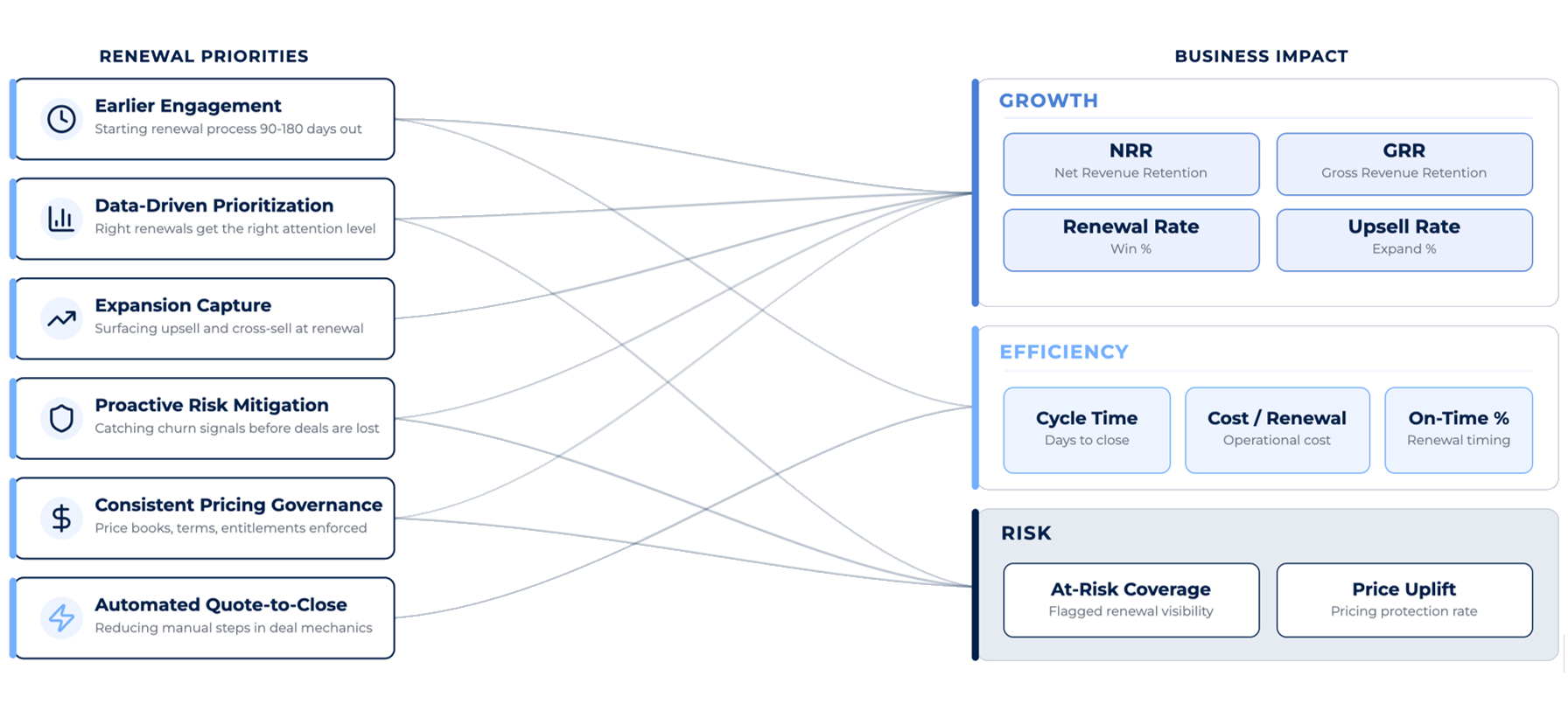
When your renewal strategy is handled with intent, you’ll see impact on revenue and beyond. Organizations that approach renewals strategically tend to see improvements across several dimensions at once:
- Multi-year terms with built-in uplift. High-performing teams do not treat renewals as single-cycle events. They use them to extend the duration of the customer relationship while increasing contract value over time. This creates compounding annual recurring revenue and reduces churn by locking in longer commitments.
- Expansion. Customers are already evaluating the value they receive, which makes them more receptive to conversations about complementary solutions, increased usage, or broader adoption. Compared to mid-cycle outreach, these expansion efforts typically convert at higher rates because they align with an existing renewal process rather than interrupting it.
- Standardized agreement structure. While bespoke agreements tend to offer flexibility for customers, they are extremely challenging to manage and report on. Pushing towards standardization and an online set of terms and conditions minimizes impacts when the business changes direction and provides a single place for all clients to access terms.
The diagram below reflects how these factors intersect to drive broader business outcomes.
The first step towards renewal maturity is understanding where you are now
Organizations tend to progress through a set of stages as they mature their renewal processes. Each stage reflects a different level of structure, insight, and scalability:
- Reactive: There are no standard workflows, and each renewal depends on individual effort to close. Outcomes vary widely, and success is tied to specific people rather than a repeatable process.
- Defined: A clear plan is in place, and workflows are used to guide execution. Despite this structure, results are still inconsistent, as the process lacks the nuance needed to address different types of accounts effectively.
- Predictive: Segmentation and scoring introduce a more targeted approach. Accounts are managed differently based on risk, value, and growth potential, leading to more informed engagement and improved outcomes.
- Scalable: Repetitive renewal tasks are handled by AI-driven systems. This reduces manual effort and allows teams to focus on relationship-building, strategic conversations, and expansion opportunities.
One note on data: imperfect data is not a reason to wait. When many organizations start to scale their renewals engine, they find that challenges with existing data quality can initially seem daunting to tackle. However, the state of your data only affects where you start, not whether you can improve. Fixing a few critical data issues, such as contract dates, ownership, and entitlement records, unlocks a disproportionate amount of automated volume. Start there.

At each stage, the path forward comes from targeted improvements to address specific gaps in process, data, and execution.
How to build renewal maturity at each stage:
Each level of maturity introduces requirements in process, data, and execution. At every step, align on the requirements needed to move forward, the process changes that address those requirements, and the systems that support consistent execution. This is where AI agents begin to play a practical role, handling specific tasks within each stage and providing smart automation so your team can focus on the work that requires thought capital.
Reactive: Building the fundamental processes
At the reactive stage, the priority is establishing control and visibility. Without clear ownership, reliable data, and a basic understanding of performance, it is difficult to improve outcomes in any structured way.
Requirements
- Identify renewal owners and assign accountability for each contract
- Catalog existing contracts in a centralized system
- Establish a baseline for key metrics
Process changes
- Assign clear ownership for every contract
- Define a renewal calendar with key dates and milestones
- Begin tracking core metrics such as renewal rate and timing
Agentic support
- Standardizing records
- Validating contract dates
- Correcting entitlement data
This stage is about creating a manageable system. Once ownership, data, and basic tracking are in place, the organization has a foundation to build more consistent processes.
Defined: Documenting and prioritizing
At the defined stage, the focus shifts from basic control to consistency. The goal is to ensure that renewals are handled in a repeatable way across teams, rather than relying on individual approaches.
Requirements
- Document renewal playbooks and standardize them across teams
- Define customer cohorts based on relevant attributes such as size, product usage, or contract value
- Establish clear lead times for when renewal activities should begin
Process changes
- Formalize and document renewal playbooks
- Standardize execution across teams to reduce variability
- Implement cohort definitions to guide how different accounts are managed
Agentic support
- Assign accounts to the correct cohorts based on defined criteria
- Prioritize renewals based on timing, risk, and value
At this stage, consistency becomes the main driver of improvement. With standardized processes and clear segmentation, teams can begin to produce more reliable outcomes and set the groundwork for more advanced, data-driven approaches.
Predictive: Differentiated workflows
At the predictive stage, the focus moves from consistency to precision. The objective is to use data to guide how each renewal is managed, so effort is aligned with risk, value, and growth potential.
Requirements
- Score and segment renewals based on risk and value tiers
- Build differentiated workflows tailored to those segments
- Define clear rules for when and how automation should be applied
Process changes
- Develop and refine scoring models to assess renewal risk and opportunity
- Define workflow rules that align actions to each segment
- Establish automation triggers tied to timing, account signals, and key events
Agentic support
- Support quote-to-close processes, including pricing, approvals, and document generation
- Manage deal mechanics, ensuring accuracy and consistency in how renewals are structured and executed
In highly regulated environments, these workflows may also incorporate approval controls, documentation requirements, and auditability standards that are less common in many SaaS renewal motions.
At this stage, improvements come from applying the right level of effort to the right accounts. Data-driven segmentation and workflow design allow teams to operate more efficiently while increasing the likelihood of both retention and expansion.
Scalable: Continuous improvement
At the scalable stage, the focus shifts to continuous improvement and full operational leverage. The renewal process is no longer something that needs to be managed step by step. It becomes a system that adapts, learns, and improves over time.
Requirements
- Establish continuous optimization through feedback loops that refine performance
- Enable cross-portfolio benchmarking to identify patterns and outliers
- Support fully agent-driven operations across the renewal lifecycle
Process changes
- Implement ongoing optimization cycles based on performance data
- Build feedback loops that capture outcomes and feed them back into workflows
- Introduce cross-portfolio benchmarking to compare performance across segments and teams
Agentic support
- Coordinate workflows, systems, and handoffs
- Determine and route next best actions based on real-time context
- Manage internal and external communications, ensuring timely and consistent engagement
For SaaS businesses, these actions may be driven by product telemetry and customer engagement data. For medical device organizations, they may incorporate service events, asset performance data, contract milestones, and account-level operational indicators. At this stage, the system operates with a high degree of autonomy. Human effort is focused on exceptions and strategic decisions, while the underlying process continues to improve through structured feedback and broad visibility across the portfolio.
Start from where you are
The companies that solve renewals will do it by investing in data. While AI can continuously monitor customer signals, personalize engagement at scale, surface expansion opportunities, and intervene before churn becomes inevitable, it relies on the information you feed it. Getting sales data right and building your renewal engine with it in mind will make renewals a competitive advantage. Sales teams owe it to themselves to start now.
This doesn’t need to be done all at once. Quick proof-of-concept wins can help you progress to the next maturity level and deliver notable benefits on their own. If your business is just getting started, consider a strategic partner to help you prioritize, set a plan, and improve performance around renewals. We’re ready to help.
.webp)